Shards and Segmentation in EON: Why Data Distribution Ignores Projection Segmentation
1. The Short Version
Ask how EON distributes data and the usual answer is “by the projection’s segmentation”. That is not wrong, but it skips a layer — and skipping it makes capacity math, skew checks, and shard-pruning expectations all wrong. I worked the whole thing through with read-only queries on a local three-node eondb (v25.4.0-0, K-Safe=0, four shards). Seven findings:
- Placement is “which shard holds this hash value”, not “hash mod node count”. The three segment shards cover
0–4,294,967,295contiguously, totalling4,294,967,296=2^32with zero gap, and each is owned by exactly one node’s primary subscription. - Placement can be reproduced exactly.
ADA.GCIS_Companyinfo_CmpB(13,245,243 rows, segmented byhash(id)) bucketed withhash(id) % 4294967296yields4,413,479/4,419,435/4,412,329rows — identical to the three ROS containers’total_row_count. A second table with 1,093,169 rows reproduces the same way:365,062/365,354/362,753. - Segmentation did not disappear; it only supplies the hash input. 408 of the 486 rows in
v_catalog.projectionshaveis_segmented = truewith a fullhash(...)expression, yetsegment_rangein EON only saysimplicit range: each node[33.3%]. The boundaries exist only inv_catalog.shards. - Unsegmented tables go to the replica shard, one copy per node. The 26
is_segmented = falseprojections occupy 78 catalog rows (three each,node_namepopulated) and 15 containers — 5 per node, 100,043 rows and 2,786,722 bytes each. - K-Safe is countable.
v_catalog.node_subscriptionshas six rows: three forreplica(1 primary + 2 secondary) and one per segment. No buddies, so the database is 0-safe and greets every connection withWARNING 6046. - The three segments carry nearly identical load. 366,727,810 / 366,526,751 / 366,396,866 rows — 33.34% / 33.32% / 33.31%, a spread of 0.03 percentage points.
- Shard pruning is real. An equality predicate on the segmentation column produces
Execute on: v_eondb_node0003and runs in 5.5–7.3 ms. The same table filtered on a non-segmentation column becomesAll Nodesand takes 58.0–58.5 ms.
This is for three audiences: people who assume shard count equals node count and mis-size their depot; people staring at the 33.3% in segment_range and failing to find hash boundaries; and people who need to know whether a query will hit one node or all three. Every number labelled “measured” comes from the 2026-11-14 run; mechanism explanations come from the documentation linked at the end. Everything was read-only — nothing on the cluster was changed.
2. Test Environment
| Item | Value |
|---|---|
| Vertica version | Vertica Analytic Database v25.4.0-0 |
| Database | eondb (EON mode) |
| Nodes | 3 (v_eondb_node0001/0002/0003, node_type = PERMANENT, all UP) |
| Shards | 4 (1 replica + 3 segment), default_shard_count = 3 |
| Node subscriptions | 6 (replica 3, one per segment*) |
| K-Safe | 0 (WARNING 6046 on connect) |
| Communal storage | s3://verticadb/eondb |
| Containers and rows | 1,381 ROS containers, 221 projections, 1,099,951,556 rows, disk_size 12,047,766,999 bytes |
| Baseline | Local testdb (Enterprise mode, single node, same v25.4.0-0) |
| Access | eondb via vertica_python (endpoints 1533/2533/3533 all point at the same cluster), testdb via vsql-testdb; only SELECT and EXPLAIN |
The baseline is single-node, so I could not reproduce Enterprise’s multi-node hash-range split locally. What I could measure is that Enterprise has no shard layer at all, and that a single node owns the entire 32-bit ring — numbers in section 6.
3. The Core Model: Three Layers, and You Need All Three
| Layer | Answers | Source | Numbers here |
|---|---|---|---|
| segmentation | which columns feed a row’s hash input | v_catalog.projections.segment_expression |
408 segmented projections, e.g. hash(GCIS_Companyinfo_CmpB.id) |
| shard | how many pieces the hash space is cut into, and where the cuts are | v_catalog.shards |
4 rows (3 segment + 1 replica), bounds at 0 / 1,431,655,739 / 2,866,311,478 |
| node subscription | which node owns which shard | v_catalog.node_subscriptions |
6 rows |
| ROS container | which files on which node belong to which shard | v_monitor.storage_containers |
1,381 rows, shard_name populated |
In one sentence: segmentation decides what a row’s hash is; the shard decides who owns that hash. Once those are separate questions, several things fall into place:
- Adding a node does not change segmentation, but it does redistribute shards (the docs call this rebalancing shards).
K-Safeis a property of a shard (how many subscriptions it has), not of a projection.- To find out where data sits,
v_catalog.projectionswill not help;v_catalog.shardswill.
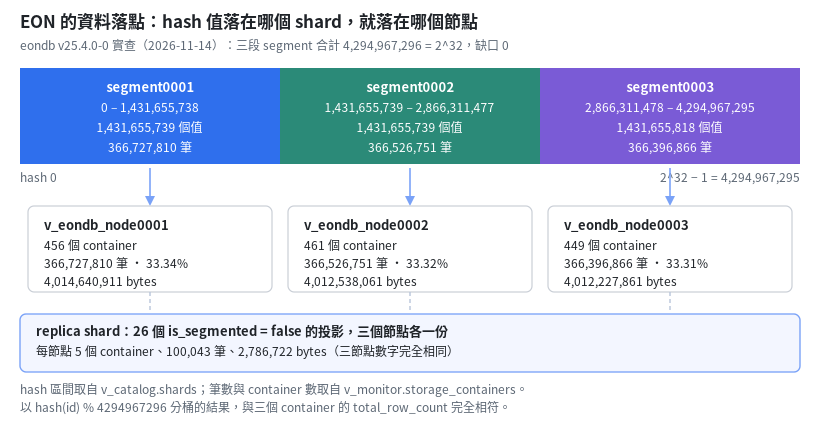
Every number in that diagram comes from this run: the three hash-range sizes, the per-node container and row counts, and the three copies of the replica shard.
4. Step by Step: Reconstructing Placement
4.1 Shard boundaries and gaps
=> SELECT shard_name, shard_type, lower_hash_bound, upper_hash_bound,
          upper_hash_bound - lower_hash_bound + 1 AS hash_values
   FROM v_catalog.shards ORDER BY shard_name;

  shard_name  | shard_type | lower_hash_bound | upper_hash_bound | hash_values
--------------+------------+------------------+------------------+-------------
 replica      | Replica    |                  |                  |
 segment0001  | Segment    | 0                | 1431655738       |  1431655739
 segment0002  | Segment    | 1431655739       | 2863311477       |  1431655739
 segment0003  | Segment    | 2863311478       | 4294967295       |  1431655818

=> SELECT shard_name, lo, hi, (hi - lo + 1) AS span,
          sum(hi - lo + 1) OVER () AS total_span,
          lo - lag(hi) OVER (ORDER BY lo) - 1 AS gap_before
   FROM (SELECT shard_name, lower_hash_bound lo, upper_hash_bound hi
         FROM v_catalog.shards WHERE shard_type = 'Segment') s
   ORDER BY lo;

  shard_name  |     lo     |     hi     |   span    | total_span | gap_before
--------------+------------+------------+-----------+------------+------------
 segment0001  |          0 | 1431655738 | 1431655739 | 4294967296 |
 segment0002  | 1431655739 | 2863311477 | 1431655739 | 4294967296 |          0
 segment0003  | 2863311478 | 4294967295 | 1431655818 | 4294967296 |          0
Both gap_before values are 0, and total_span is 4,294,967,296 — exactly 2^32. Bounds are inclusive: segment0001 is 0 ≤ h ≤ 1,431,655,738 and the next range starts at 1,431,655,739, so lengths need hi - lo + 1, not hi - lo.
These boundaries match the ones in the previous article (the EON architecture overview) exactly, but the container counts and row counts moved since then: yesterday 1,394 containers at 450/484/445; today 1,381 at 456/461/449. Shard boundaries are configuration; containers are files that mergeout rewrites. They do not change on the same timescale.
4.2 Which node owns which shard
=> SELECT node_name, shard_name, is_primary, subscription_state
   FROM v_catalog.node_subscriptions ORDER BY node_name, shard_name;

     node_name     |  shard_name  | is_primary | subscription_state
-------------------+--------------+------------+--------------------
 v_eondb_node0001  | replica      | True       | ACTIVE
 v_eondb_node0001  | segment0001  | True       | ACTIVE
 v_eondb_node0002  | replica      | False      | ACTIVE
 v_eondb_node0002  | segment0002  | True       | ACTIVE
 v_eondb_node0003  | replica      | False      | ACTIVE
 v_eondb_node0003  | segment0003  | True       | ACTIVE
The shape of those six rows is the answer. Each node is primary for its own segment; for replica, node0001 is primary and the other two are secondaries. K-Safe is “subscriptions per segment, minus one”, and every segment here has exactly one:
=> SELECT shard_name, count(*) subs,
          sum(CASE WHEN is_primary THEN 1 ELSE 0 END) primaries
   FROM v_catalog.node_subscriptions GROUP BY 1 ORDER BY 1;

  shard_name  | subs | primaries
--------------+------+-----------
 replica      |    3 |         1
 segment0001  |    1 |         1
 segment0002  |    1 |         1
 segment0003  |    1 |         1
4.3 Reconstructing the hash from real data
Pick a table with a single-column segmentation and enough rows to matter: ADA.GCIS_Companyinfo_CmpB, segmented by hash(id), 13,245,243 rows. Its three containers hold 4,413,479 / 4,419,435 / 4,412,329 rows. Now bucket the table in SQL and see whether the same three numbers come out:
=> SELECT CASE WHEN (hash(id) % 4294967296) <= 1431655738 THEN 'segment0001'
               WHEN (hash(id) % 4294967296) <= 2863311477 THEN 'segment0002'
               ELSE 'segment0003' END AS shard_from_hash,
          count(*) AS rows_
   FROM ADA.GCIS_Companyinfo_CmpB GROUP BY 1 ORDER BY 1;

 shard_from_hash |  rows_
-----------------+---------
 segment0001     | 4413479
 segment0002     | 4419435
 segment0003     | 4412329
Against v_monitor.storage_containers:
=> SELECT node_name, shard_name, total_row_count, deleted_row_count,
          segment_lower_bound, segment_upper_bound, disk_size
   FROM v_monitor.storage_containers
   WHERE projection_name = 'GCIS_Companyinfo_CmpB_super' ORDER BY shard_name;

     node_name     |  shard_name  | total_row_count | deleted_row_count | segment_lower_bound | segment_upper_bound | disk_size
-------------------+--------------+-----------------+-------------------+---------------------+---------------------+-----------
 v_eondb_node0001  | segment0001  |         4413479 |                 0 |                   0 |          1431655738 | 114183018
 v_eondb_node0002  | segment0002  |         4419435 |                 0 |          1431655739 |          2863311477 | 114384873
 v_eondb_node0003  | segment0003  |         4412329 |                 0 |          2863311478 |          4294967295 | 113996312
The three numbers match exactly, and the containers’ segment_lower_bound / segment_upper_bound are identical to the shard bounds. A second table confirms it (ADA.GCIS_Companyinfo_Person, 1,093,169 rows, hash(id)): bucketing gives 365,062 / 365,354 / 362,753, and the containers hold 365,062 / 365,354 / 362,753.
That is the accurate version of “don’t look at projection segmentation alone”: segmentation supplies the hash input, and placement is the hash value matched against a shard range. Change the shard boundaries — a rebalance, a different shard count — and the data moves, while the projection DDL stays untouched.
4.4 Container ranges always sit inside shard ranges
If shards really are the upper-level split, no container’s hash range should escape the shard it belongs to. Check the whole cluster:
=> SELECT count(*) AS violations
   FROM v_monitor.storage_containers sc
   JOIN v_catalog.shards s ON s.shard_name = sc.shard_name
   WHERE sc.segment_lower_bound IS NOT NULL
     AND (sc.segment_lower_bound < s.lower_hash_bound
       OR sc.segment_upper_bound > s.upper_hash_bound);

 violations
------------
          0
(1 row)
Zero. Of 1,381 containers, 1,366 carry hash ranges (the other 15 are replica-shard containers for unsegmented projections, with NULL bounds), and none crosses its shard boundary.
4.5 Cluster-wide distribution
=> SELECT shard_name, count(*) containers, count(DISTINCT projection_id) projs,
          sum(total_row_count) rows_, sum(disk_size) bytes_,
          round(100.0 * sum(total_row_count) / sum(sum(total_row_count)) OVER (), 3) AS pct_rows
   FROM v_monitor.storage_containers GROUP BY 1 ORDER BY 1;

  shard_name  | containers | projs |   rows_    |   bytes_   | pct_rows
--------------+------------+-------+------------+------------+----------
 replica      |         15 |     5 |     300129 |    8360166 |    0.027
 segment0001  |        456 |   183 |  366727810 | 4014640911 |   33.340
 segment0002  |        461 |   188 |  366526751 | 4012538061 |   33.322
 segment0003  |        449 |   180 |  366396866 | 4012227861 |   33.310
The container counts (456/461/449) differ because mergeout is at different stages, but the row counts barely do: 33.34% / 33.32% / 33.31%. That is what a healthy shard layout looks like: container counts wobble, row counts do not. If one segment holds 40% and another 20%, that is not “containers haven’t merged yet” — that is genuine hash skew, and the first thing to inspect is the segmentation column.
The projs column counts projections with containers on that shard: 183, 188, 180, plus 5 on replica. Together they form 551 (projection, shard) pairs, 556 including replica, mapping to 221 distinct projections that actually hold containers. Comparing this to the catalog is a mistake waiting to happen; compare count(DISTINCT projection_id) instead.
4.6 Turning Shards Into Capacity
=> SELECT shard_name, sum(disk_size) bytes_,
          round(100.0 * sum(disk_size) / sum(sum(disk_size)) OVER (), 3) AS pct_bytes
   FROM v_monitor.storage_containers GROUP BY 1 ORDER BY 1;

  shard_name  |   bytes_   | pct_bytes
--------------+------------+-----------
 replica      |    8360166 |     0.069
 segment0001  | 4014640911 |    33.323
 segment0002  | 4012538061 |    33.305
 segment0003  | 4012227861 |    33.303
Each segment holds about 4.01 GB; the replica shard holds 8.36 MB, or 0.069%. disk_size is compressed bytes actually stored in containers, not raw data size, so these numbers map to disk footprint per node rather than to ingest volume.
Two practical consequences. First, each node’s depot has to hold its 4.01 GB plus the 8.36 MB replica copy; anything that does not fit gets evicted and the query has to go back to communal storage. Second, on this cluster, sizing by node count and sizing by shard count happen to agree (three and three), so the distinction is invisible here. Once the shard count differs from the node count — say default_shard_count = 6 on three nodes — capacity must be computed per shard, because what is being divided is data, not machines.
5. So How Many Projections Are Those 486 Rows?
=> SELECT is_segmented, count(*) rows_, count(DISTINCT projection_id) ids
   FROM v_catalog.projections GROUP BY 1;

 is_segmented | rows_ | ids
--------------+-------+-----
 False        |    78 |  26
 True         |   408 | 408

=> SELECT n, count(*) AS proj_ids
   FROM (SELECT projection_id, count(*) n FROM v_catalog.projections GROUP BY 1) x
   GROUP BY 1 ORDER BY 1;

 n | proj_ids
---+----------
 1 |      408
 3 |       26
Read those two results and the catalog stops misleading you:
- A segmented projection has exactly one row, with
node_nameempty — it belongs to no single node, because its data is spread across all three shards by hash. - An unsegmented projection has three rows, one per node with
node_namepopulated — because its data sits on the replica shard, one copy per node.
So 486 rows = 408 segmented projections + 26 unsegmented projections × 3. SELECT count(*) FROM v_catalog.projections does not return a projection count; it returns projection × placement rows.
Now segment_range:
=> SELECT DISTINCT segment_range FROM v_catalog.projections WHERE is_segmented LIMIT 1;

 implicit range: v_eondb_node0001[33.3%] v_eondb_node0002[33.3%] v_eondb_node0003[33.3%]
It tells you each node takes 33.3%, and nothing about where the cuts are. For the cuts you have to read v_catalog.shards. That is the point of this article’s title: distribution is not something you read off a projection’s segmentation — the projection tells you the hash input, the shard table tells you the destination.
5.1 Four Numbers That Get Mixed Up
=> SELECT (SELECT count(*) FROM v_catalog.projections) AS catalog_rows,
          (SELECT count(DISTINCT projection_id) FROM v_catalog.projections) AS catalog_projs,
          (SELECT count(*) FROM v_monitor.storage_containers) AS containers,
          (SELECT count(DISTINCT projection_id) FROM v_monitor.storage_containers) AS projs_with_data;

 catalog_rows | catalog_projs | containers | projs_with_data
--------------+---------------+------------+-----------------
          486 |           434 |       1381 |             221
Four numbers, four questions: 486 is projection × placement rows; 434 is the real projection count in the catalog; 1,381 is the number of ROS containers; 221 is the number of projections that currently hold files. Put all four in the same health-check output and “why does the projection count keep changing?” stops being a mystery — the number that moves is usually 221, because mergeout and new projections both touch it.
The unsegmented inventory is worth looking at daily too:
=> SELECT projection_name, count(*) containers, count(DISTINCT node_name) nodes,
          sum(total_row_count) rows_
   FROM v_monitor.storage_containers WHERE shard_name = 'replica'
   GROUP BY 1 ORDER BY 4 DESC;

         projection_name          | containers | nodes |  rows_
----------------------------------+------------+-------+--------
 customer_dimension_flex2_1_unseg |          3 |     3 | 150000
 xxx_unseg                        |          3 |     3 | 150000
 lowi_user_save_source_unseg      |          3 |     3 |    114
 scheduled_task_unseg             |          3 |     3 |      9
 lowi_user_save_channel_unseg     |          3 |     3 |      6
Five projections, 15 containers, 300,129 rows — 100,043 rows per node. containers = 3 together with nodes = 3 is the evidence that all three nodes hold a copy; a projection showing nodes = 2 means one node’s replica subscription is missing or still syncing, and that is worth investigating the same day.
6. The Enterprise Baseline: No Shard Layer at All
testdb on the same machine (Enterprise mode, single node, same version):
=> SELECT count(*) AS shard_rows FROM v_catalog.shards;

 shard_rows
------------
          0

=> SELECT count(*) containers,
          sum(CASE WHEN segment_lower_bound = 0 AND segment_upper_bound = 4294967295 THEN 1 ELSE 0 END) full_ring
   FROM v_monitor.storage_containers;

 containers | full_ring
------------+-----------
       1494 |      1483
Two clear signals:
- Enterprise has no shards.
v_catalog.shardsreturns zero rows, andv_monitor.storage_containers.shard_nameis an empty string for every row. - A single node owns the whole 32-bit ring. 1,483 containers span
0–4294967295; the remaining 11 are unsegmented projections with NULL bounds.
The catalog agrees: testdb has 433 rows and 433 distinct projection_id values (one row per projection, because there is one node), 411 of them segmented. The same count(*) means “number of projections” in Enterprise and something else entirely in EON — an easy trap when writing health-check SQL.
I have no multi-node Enterprise environment, so I will not quote measured numbers for how Enterprise splits segmentation ranges across nodes. Mechanically: Enterprise maps a projection’s segmentation directly onto nodes, so adding a node requires re-segmenting; EON maps shards onto nodes, so adding a node means moving shards. The documentation links at the end cover the mechanics.
Three things break most often in health-check SQL when you move from Enterprise to EON: SELECT count(*) FROM v_catalog.projections (EON counts the per-node copies of unsegmented projections as well), WHERE shard_name IS NULL (Enterprise stores an empty string, not NULL, so the predicate matches nothing), and any join that assumes one projection maps to one node. The fixes are the same everywhere: count projections with count(DISTINCT projection_id), read node ownership from v_catalog.node_subscriptions, and read placement from v_monitor.storage_containers.shard_name.
7. Query Side: What Shard Pruning Looks Like
An equality predicate on the segmentation column:
=> EXPLAIN SELECT count(*) FROM ADA.GCIS_Companyinfo_CmpB
   WHERE id = '3cc5cd9e-253e-11eb-9cb0-005056b1498c';

+-GROUPBY NOTHING [Cost: 19K, Rows: 1 (ROW COUNT ONLY)] (PATH ID: 1)
|  Aggregates: count(*)
|  Execute on: v_eondb_node0003
| +---> STORAGE ACCESS for GCIS_Companyinfo_CmpB [Cost: 19K, Rows: 13M ...]
| |      Projection: default_namespace.ADA.GCIS_Companyinfo_CmpB_super
| |      Filter: (GCIS_Companyinfo_CmpB.id = '3cc5cd9e-...')
| |      Execute on: v_eondb_node0003
Execute on: names one node. A row’s hash lands on exactly one shard, so only one node has to work. Switch to a non-segmentation column:
=> EXPLAIN SELECT count(*) FROM ADA.GCIS_Companyinfo_CmpB
   WHERE business_seq_no = '0021';

+-GROUPBY NOTHING [Cost: 6K, Rows: 1 (ROW COUNT ONLY)] (PATH ID: 1)
|  Aggregates: count(*)
|  Execute on: All Nodes
| +---> STORAGE ACCESS for GCIS_Companyinfo_CmpB [Cost: 6K, Rows: 13M ...]
| |      Filter: (GCIS_Companyinfo_CmpB.business_seq_no = '0021')
| |      Execute on: All Nodes
Same table, All Nodes. Timings (same connection, warm depot, three runs each, minimum shown):
| Query | Nodes scanned | Rows returned | Best time |
|---|---|---|---|
WHERE id = '3cc5cd9e-…' (segmentation column) |
1 (node0003) | 1 | 5.5 ms |
WHERE id = 'ffffffff-…' (nonexistent key) |
1 | 0 | 4.8 ms |
WHERE business_seq_no = '0021' (not segmentation) |
3 (All Nodes) | 174,498 | 58.0 ms |
SELECT count(*) (whole table) |
3 | 13,245,243 | 15.3 ms |
Two caveats. First, this is not an apples-to-apples benchmark: the row counts differ by five orders of magnitude, and the 58 ms is mostly the cost of scanning 13M rows, not the node count. Second, count(*) is not a performance metric: 13M rows in 15.3 ms works because the plan answers from ROS statistics — it says ROW COUNT ONLY — without touching the data.
7.1 Participating subscriptions Is Not the Pruned Set
The GraphViz block at the end of the plan lists this:
All Nodes Vector:
  node[0]=v_eondb_node0001 (initiator) Up
  node[1]=v_eondb_node0002 (executor) Up
  node[2]=v_eondb_node0003 (remote initiator) Up

Participating subscriptions:
  replica: [<0, 1, 2>]
  segment0001: [<0>]
  segment0002: [<1>]
  segment0003: [<2>]
It is byte-for-byte identical in the single-key query and in the full-table count(*) — because it lists which subscriptions exist in the cluster, not which ones this query used. Pruning shows up in the Access Path’s Execute on: line: v_eondb_node0003 for the point lookup, All Nodes for the full scan. Confusing the two leads straight to “EON does no shard pruning at all”, followed by pointless segmentation changes — when the real problem was misreading the plan.
8. Common Mistakes and Anti-Patterns
1. Comparing hash() directly against shard bounds. My first attempt was CASE WHEN hash(id) <= 1431655738 …, which put all 13,245,243 rows in segment0003, because hash() returns a 64-bit BIGINT (the minimum value in that table was 293,223,774,726) and is always greater than the 4,294,967,295 ceiling. The working form is hash(id) % 4294967296.
2. Treating count(*) on v_catalog.projections as a projection count. In EON, 486 rows means 434 projections (408 + 26×3). Use count(DISTINCT projection_id) for projections, count(*) for placement rows.
3. Assuming shard count equals node count. Three nodes, four shards, and default_shard_count = 3 counts segments only. Size a depot with one number and validate with the other, or you will spend an afternoon wondering which table lies.
4. Comparing the projection count in v_monitor.storage_containers with the catalog. The view lists projections that have files (221 here); the catalog lists 434. The gap is projections with no data yet (DELAYED CREATION) plus in-flight mergeout containers. Both numbers are correct answers to different questions.
5. Expecting hash boundaries inside segment_range. EON’s segment_range reports node percentages only. Boundaries live in v_catalog.shards.
6. Using node_name to decide where data is. It is empty for segmented projections, and populated on all three nodes for unsegmented ones. Read v_monitor.storage_containers.shard_name instead.
9. Risks and Recommendations
Do now (read-only, low risk)
- Add “shard boundaries plus per-segment rows” to the daily health check: the three
spanvalues must sum to4,294,967,296and everygap_beforemust be 0. - Track row share per
shard_namefromv_monitor.storage_containers; anything more than two percentage points off 33% deserves a look at segmentation skew. - Check
v_catalog.node_subscriptions: subscriptions per segment equal K-Safe + 1. Fewer than expected means a copy is missing. - For slow queries, read
Execute on:inEXPLAIN. If it saysAll Nodeswhen you expected one, the predicate is not on the segmentation column.
Needs a change window
- Changing the shard count triggers a rebalance that moves data between nodes — not a read-only operation.
- Raising K-Safe adds subscriptions and needs spare nodes and depot space; this cluster has three nodes at K-Safe=0, so moving to 1 needs planning.
- Changing a projection’s segmentation requires rebuilding it, which rewrites the data.
10. References
- Vertica 25.4 documentation: Shards and subscriptions — https://docs.vertica.com/25.4.x/en/architecture/eon-mode-architecture/shards-and-subscriptions/
- Vertica 25.4 documentation:
v_catalog.shards— https://docs.vertica.com/25.4.x/en/sql-reference/system-tables/v-catalog-tables/shards/ - Vertica 25.4 documentation:
v_catalog.node_subscriptions— https://docs.vertica.com/25.4.x/en/sql-reference/system-tables/v-catalog-tables/node-subscriptions/ - Vertica 25.4 documentation: Segmentation clause (
CREATE PROJECTION) — https://docs.vertica.com/25.4.x/en/sql-reference/statements/create-projection/segmentation-clause/ - Vertica 25.4 documentation: Projection segmentation — https://docs.vertica.com/25.4.x/en/architecture/projection-design/segmentation/
- Vertica 25.4 documentation:
HASHfunction — https://docs.vertica.com/25.4.x/en/sql-reference/functions/hash/
Note:
docs.vertica.comcurrently 302-redirects todocs.rocketsoftware.com/bundle/vertica_25.4/with the same paths; all links above returned 200 when checked on 2026-11-14.
FAQ
Does EON distribute data by projection segmentation or by shard?
They divide the work: segmentation decides which columns feed the hash, and the shard decides which node owns that hash value. Bucketing `ADA.GCIS_Companyinfo_CmpB` (13,245,243 rows, segmented by `hash(id)`) with `hash(id) % 4294967296` gave 4,413,479 / 4,419,435 / 4,412,329 rows, matching the three ROS containers' `total_row_count` exactly. Those boundaries only exist in `v_catalog.shards`; `v_catalog.projections.segment_range` just reports "implicit range: 33.3% per node".
Why do the shard boundaries use 32 bits when hash() returns a 64-bit value?
`v_catalog.shards.lower_hash_bound` and `upper_hash_bound` are 32-bit integers topping out at 4,294,967,295, while `hash()` returns a 64-bit BIGINT. Comparing `hash(id)` directly against the bounds put all 13,245,243 rows in `segment0003`, because 64-bit values almost always exceed 4.29e9. Applying `hash(id) % 4294967296` first is what reproduces the three container row counts.
How do I read K-Safe straight out of the system tables?
Count `v_catalog.node_subscriptions`: six rows here, three for `replica` (one primary, two secondary) and one each for `segment0001` through `segment0003`. No segment has a buddy copy, so K-Safe = 1 − 1 = 0, and the driver reports `WARNING 6046` on connect.
Where do tables without segmentation (is_segmented = false) live in EON?
On the replica shard, one copy per node. The 26 unsegmented projections here occupy 78 rows in `v_catalog.projections` (three each, with `node_name` populated) and 15 containers in `v_monitor.storage_containers`: 300,129 rows and 8,360,166 bytes, which is 5 containers, 100,043 rows and 2,786,722 bytes per node, identical across all three.